
This is a sample edition of AI Investment Brief, showing what subscribers receive each week. Subscribe to get our next edition and an invitation to live conference calls.
Coverage: Does AI revenue pay for its costs?
How much does the AI buildout currently cost? Well, capital in service is the $473bn of AI equipment and data centers already running. We charge it over its life (5-6 years for chips, ~22 years for buildings), 2.4% a year of running costs, and a 15% return. That gives an annual bill of about $145bn.
Against it, infrastructure revenue runs at $176bn a year and all AI revenue at $232bn. So the capital already in the ground earns 121% of its cost from hosting alone, and 160% once model and application revenue is counted.
Capital committed for the next twelve months needs infrastructure revenue to grow 29% a year over the equipment’s life to earn the same 15% ROIC.
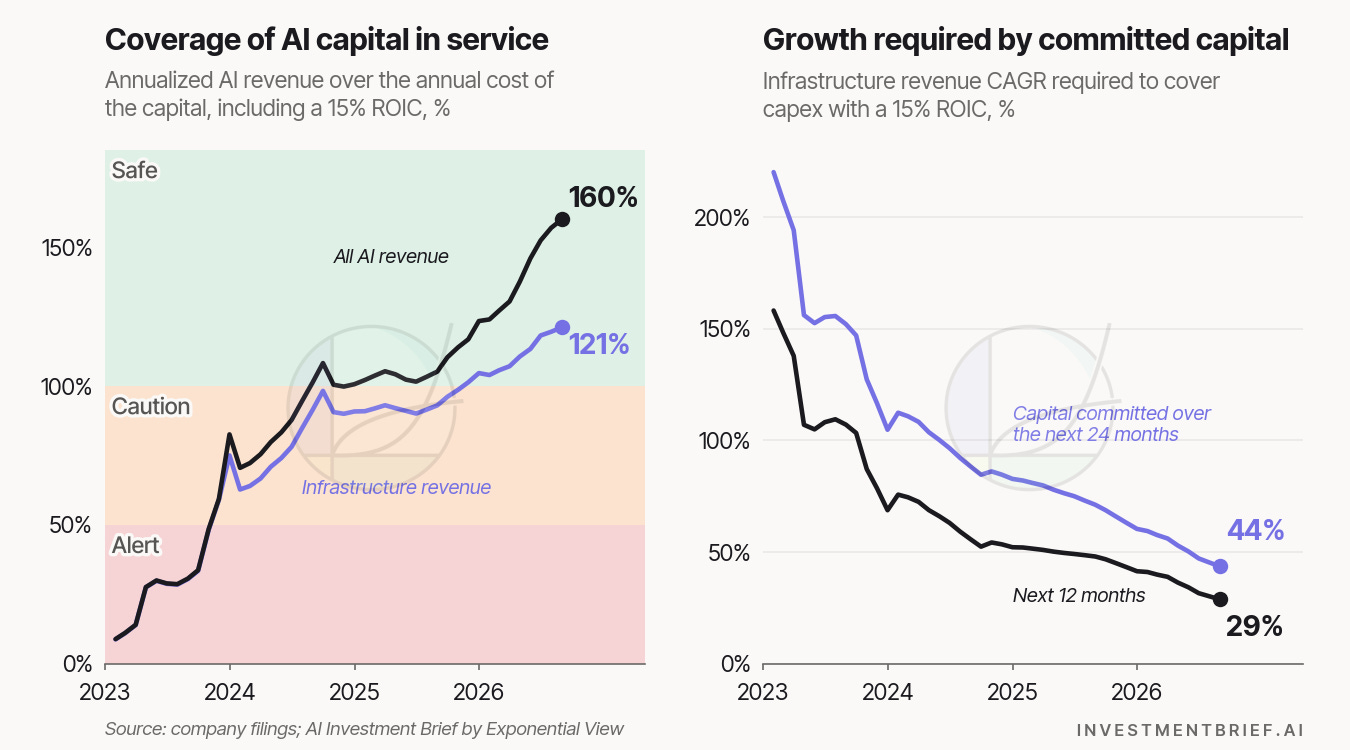
For the 24-month commitments, the hurdle is 44%. Those rates are well below last year’s 190% revenue growth. The latest compounding rate of 8.3% implies a doubling in nine months. Growth has slowed, but remains above either hurdle.
So revenue level isn’t the build-out risk. Two things could still move these dials.
The first is commitments outrunning revenue: the 44% hurdle rises when capital spending plans grow faster than revenue. Oracle reports on Thursday, and a bigger backlog on the same revenue moves the line up.
The second is revenue quality, and who pays.
Who is paying for AI growth?
More of the buildout is financed through instruments we weight as the lowest quality, such as customers whose purchases the supplier finances. The funding quality discount, the share of the build-out financed by such instruments, rose to 24.6% from 22.3% in June. It has risen every month this year. At this pace, it crosses into Alert in February 2027. Nvidia is now behind $486bn of guarantees, supply commitments and equity in its own customers, and expects a quarter of next year’s revenue from labs it finances.
The AI cohort trades at 24x, the bottom of its three-year range, and Nvidia was flat on a week it grew earnings 128%. The market may be sensing the stretch.
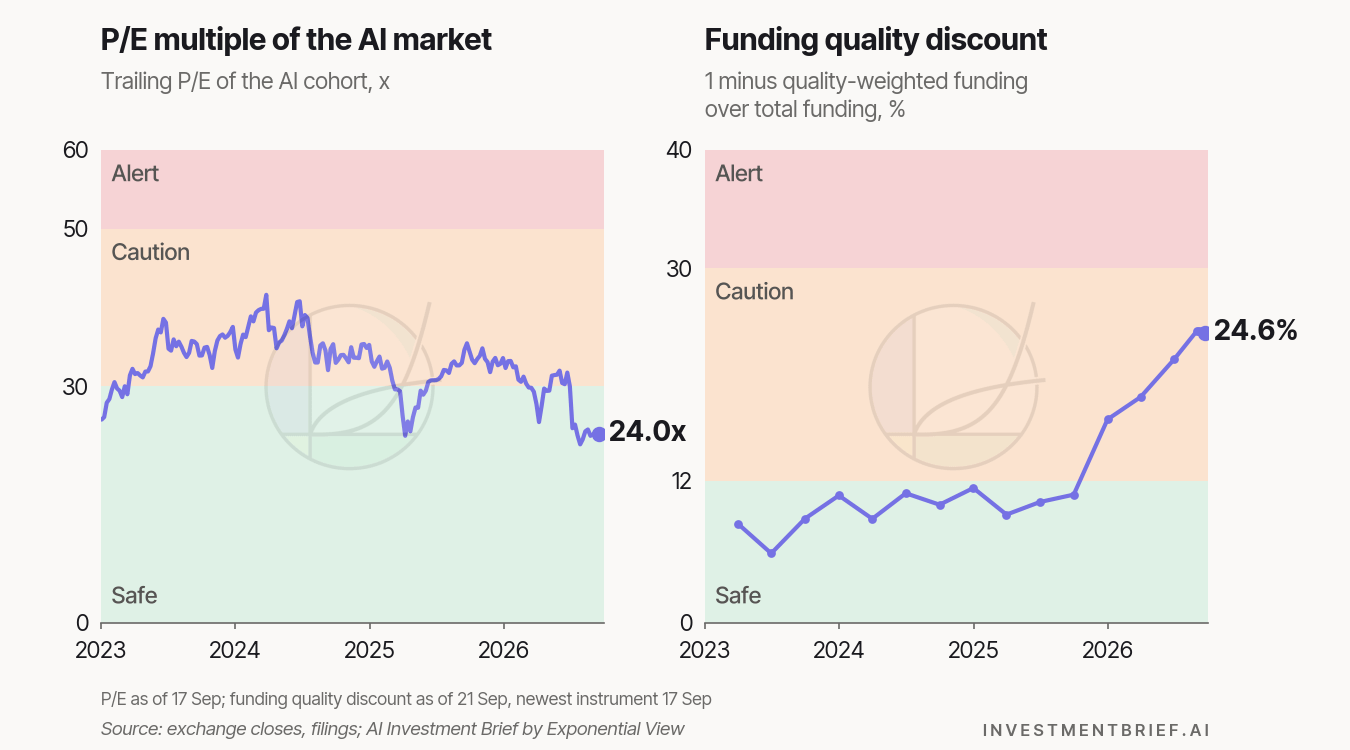
We are wary of treating that divergence as evidence that the market is wrong. For us, the growing question is how much demand stands on its own once vendor finance stops growing.
The AI economy in September

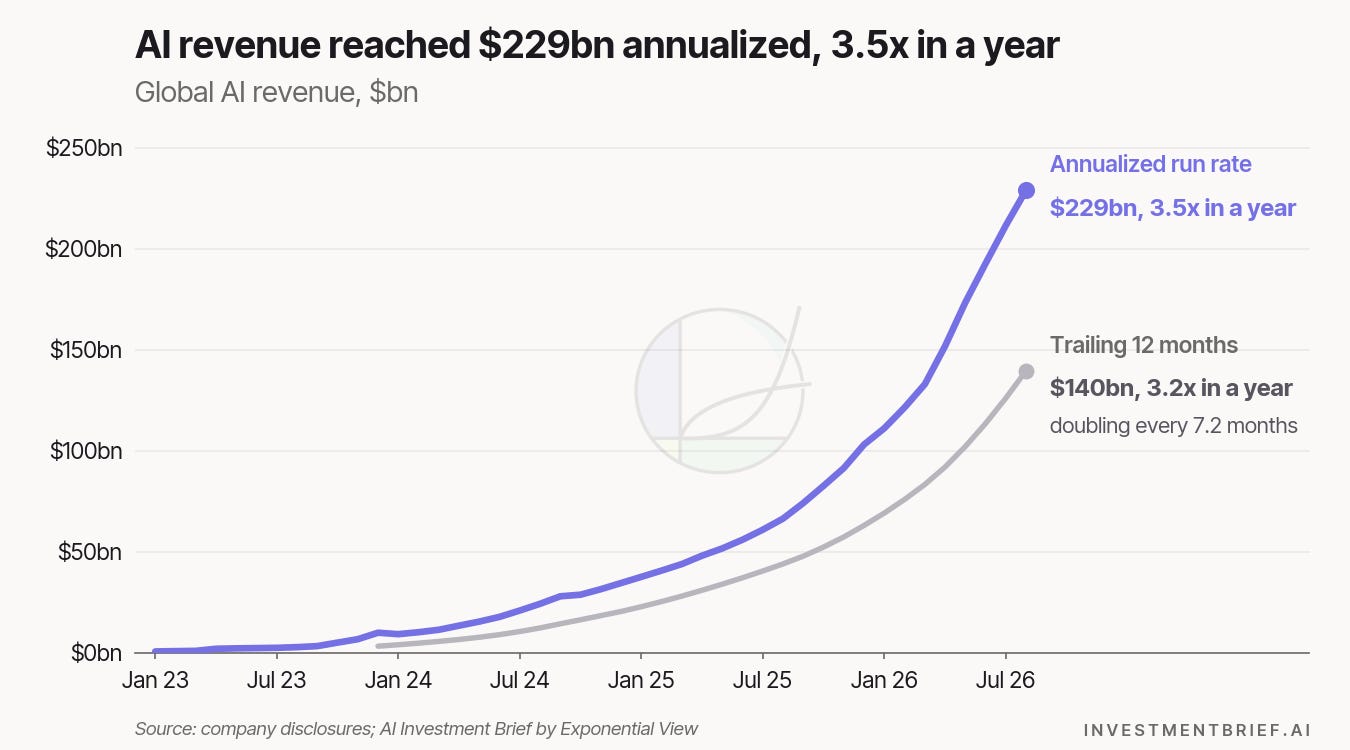
Our estimate of AI revenue reached $229bn annualized by the end of August, 3.5x the $66bn of a year earlier; July was $211bn. Trailing twelve-month revenue was $140bn, 3.2x the $44bn to August 2025; July was $126bn.
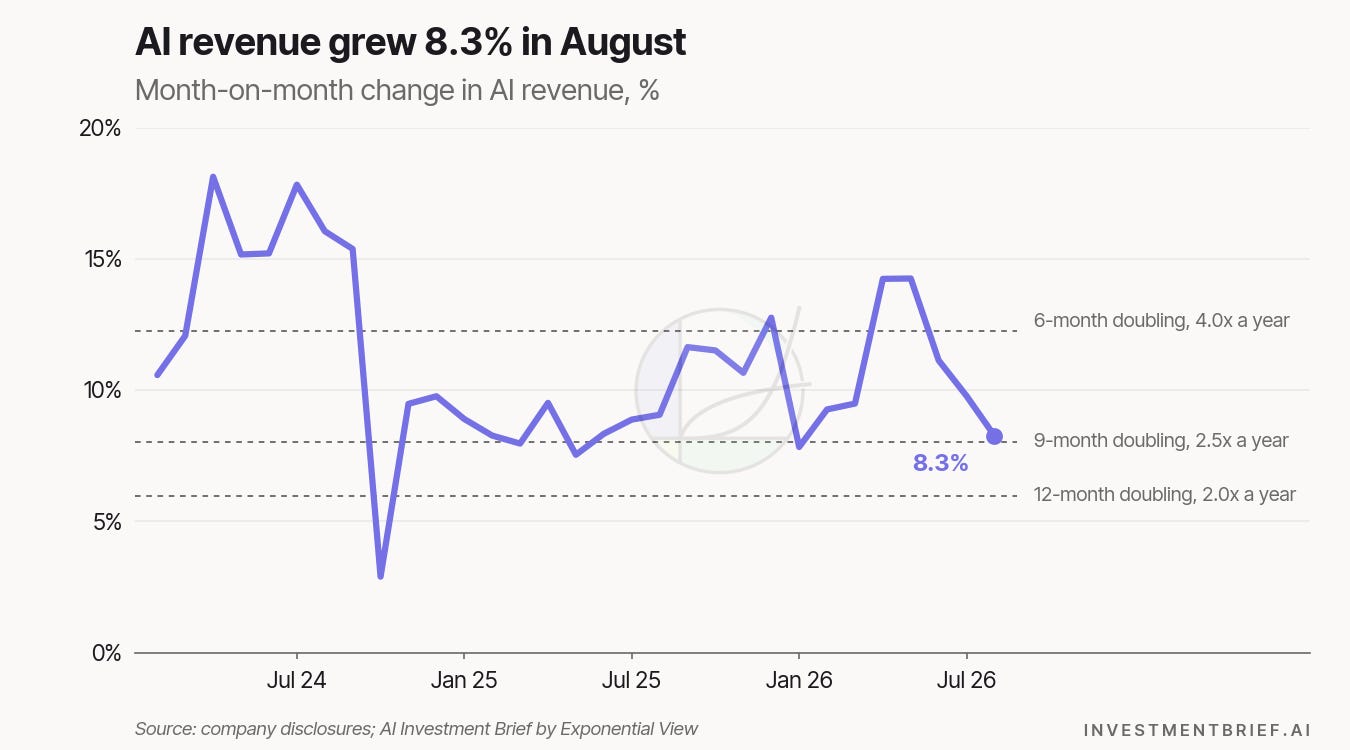
Month-on-month growth was 8.3% in August (doubling every 9 months) against a 10.9% average over the last year (doubling every 7 months).
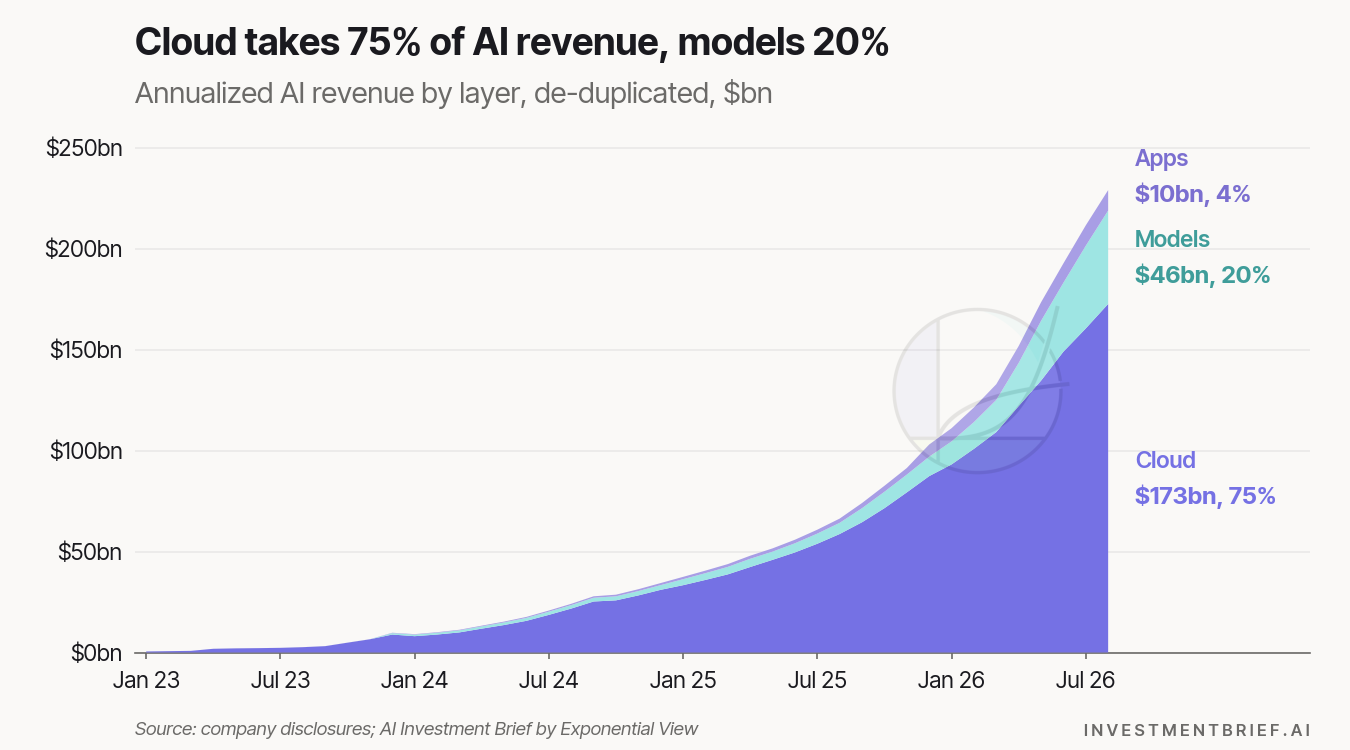
Hosting revenues are $173bn of the $229bn, three-quarters of the total, with the model layer at $46bn (20%) and applications at $10bn (4%). A year ago, cloud was 88% and models 8%; model revenue has grown 8.4x in twelve months against 2.9x for cloud. Revenue mix is shifting up the stack, predominantly to OpenAI and Anthropic.
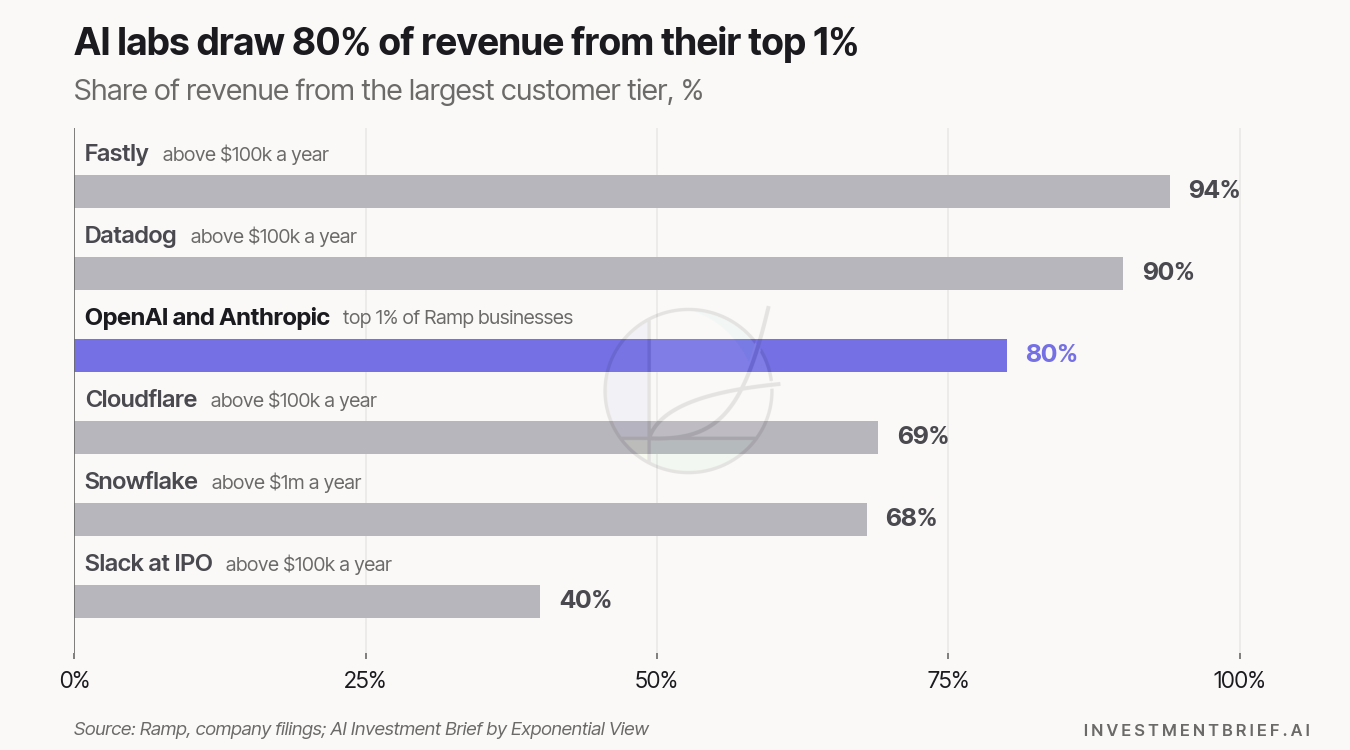
Some concerns have been raised about revenue concentration. The fintech Ramp analyzed spend data of their 70,000 enterprise customers. Ramp concludes that 80% of OpenAI and Anthropic’s enterprise revenue on Ramp’s panel comes from 1% of businesses, “a level of concentration risk unseen in any other software category we track”. Some caveats: Ramp’s customer base is digital-forward and likely not a representative sample of American businesses.
Furthermore, while this level of concentration is high, it is not without parallel. $FSLY earns 94% of revenue from its top 1% of customers. For $DDOG, it is 90%. For the AI labs, this may be a concentration issue, or a large share of American businesses may access AI through intermediary software and services firms that buy from the labs.
The paper that matters this week
We scan thousands of academic papers on AI and economics, and follow emerging technologies from frontier startups. This is our paper of the week.
Faster flash made serving slower
An August preprint from Peking and Fudan universities swaps SSDs for high-bandwidth flash (NAND stacked in the GPU package) in a simulated production stack. SSDs are a bottleneck for reloading the KV cache once it spills out of HBM.
If HBF worked, GPUs could carry terabytes of cheap flash instead of the expensive HBM. The leading HBM manufacturers are struggling to meet demand. If HBF worked, it could be cheaper – and, crucially, more supply-able. Unfortunately, it didn’t. The researchers found that although capacity doubled, latency rose by as much as 5.5x on H100 and B200. Worse, it reduced the number of concurrent users it could serve.
For $MU, $KRX:000660, and $KRX:005930, this paper suggests that HBM demand (where low latency is essential) is resilient despite ongoing efforts to increase capacity.
This is a sample analysis. To receive our full Monday and Wednesday briefings, subscribe below.